Your Calendar Looks Balanced. Your Nervous System Disagrees.

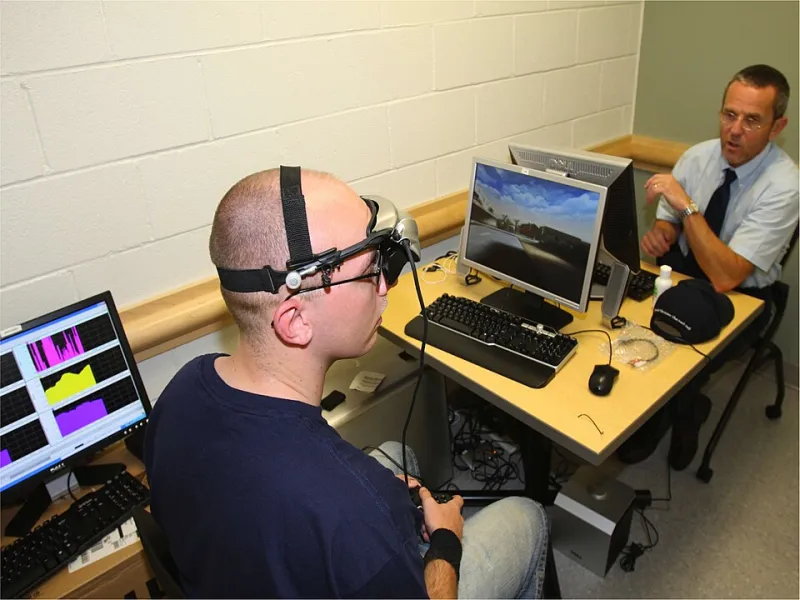
Photo: exhausted professional sitting quietly at desk appearing calm biofeedback sensors wellness clinic, via www.healthcouncilcanada.ca
There is a particular kind of exhaustion that does not show up on any schedule. It does not register in the number of vacation days taken, the frequency of weekend hikes, or the nightly wind-down routine that looks perfectly curated from the outside. Yet for millions of Americans navigating demanding careers, family obligations, and the ambient pressure of modern life, this exhaustion is not only real—it is measurable. Biofeedback technology is making that measurement possible in ways that are reshaping how clinicians understand and treat burnout.
The Performance of Balance
American culture has become increasingly fluent in the language of wellness. People track their sleep, schedule their recovery days, and describe their work-life balance with practiced confidence. Yet clinical biofeedback practitioners frequently observe a striking contradiction: individuals who present as well-rested and adequately paced often display autonomic nervous system data that tells an entirely different story.
This is what might be called the burnout masquerade—a state in which the appearance of balance coexists with profound physiological depletion. The nervous system, unlike a calendar, cannot be managed through optics. It responds to accumulated biological debt, and that debt does not clear simply because a person books a long weekend or commits to leaving the office by six o'clock.
What Biofeedback Actually Measures
To understand why biofeedback is uniquely positioned to detect hidden burnout, it helps to understand what it is actually capturing. Rather than relying on self-report—which is inherently shaped by how a person wants to perceive themselves—biofeedback instruments record real-time physiological data across multiple channels simultaneously.
The three markers most relevant to burnout assessment are heart rate variability (HRV), electrodermal activity (EDA), and surface electromyography (sEMG).
Heart Rate Variability Collapse
HRV measures the subtle fluctuations in time between consecutive heartbeats. A healthy, resilient autonomic nervous system produces considerable beat-to-beat variation—a sign that the body is fluidly responding to its environment. In individuals experiencing true burnout, HRV is characteristically suppressed, often dramatically so. The heart beats with a mechanical regularity that signals the dominance of sympathetic nervous system activation—the body's threat-response mode—even at rest.
What makes this marker particularly revealing is its persistence. Practitioners at clinics like Pulsed Biofeedback Clinic regularly observe patients whose HRV readings remain in depleted ranges even following vacations, reduced workloads, or extended sleep. The nervous system has, in a sense, forgotten how to downregulate. It has been running in a state of low-grade emergency for so long that rest no longer produces the expected physiological restoration.
Elevated Cortisol Patterns and Their Downstream Effects
Cortisol, the body's primary stress hormone, follows a natural diurnal rhythm—elevated in the morning to support wakefulness and declining through the day toward sleep. In burnout, this rhythm becomes dysregulated. Biofeedback sessions that incorporate HRV monitoring over time can reveal the autonomic signatures consistent with cortisol dysregulation: blunted morning arousal responses, afternoon energy crashes, and paradoxically elevated evening activation that interferes with sleep quality.
The individual experiencing this pattern often describes themselves as simultaneously tired and wired—unable to generate sustained daytime energy yet unable to fully relax at night. This is not a character flaw or a scheduling problem. It is a measurable disruption in the hypothalamic-pituitary-adrenal axis, and it does not resolve through willpower or a better morning routine.
Muscle Tension Signatures That Never Fully Release
Surface electromyography captures the electrical activity of muscles at rest and in motion. In chronically stressed individuals, baseline muscle tension—particularly in the trapezius, neck, and jaw—is measurably elevated even when the person is seated quietly and reports feeling relaxed. This residual tension is a physical archive of accumulated stress, and it persists because the nervous system has recalibrated its definition of "relaxed" upward.
When biofeedback practitioners show patients their own sEMG readings during a moment they describe as calm, the data frequently surprises them. The gap between perceived relaxation and actual muscular release can be substantial—and closing that gap is one of the central goals of biofeedback-assisted burnout recovery.
Why Vacations Don't Fix What Biofeedback Can Detect
One of the most common misconceptions about burnout is that it is primarily a product of overwork, and therefore addressable through rest. While rest is necessary, it is often insufficient when the nervous system has undergone sustained depletion. A two-week vacation may reduce the cognitive load temporarily, but it rarely retrains the autonomic nervous system's threat-response threshold.
Biofeedback data collected before and after periods of rest frequently confirms this. HRV scores may improve marginally following a vacation, but the underlying pattern of sympathetic dominance often reasserts itself within days of returning to normal life. This is not because the person has failed to rest adequately—it is because the nervous system requires active retraining, not merely passive recovery.
This distinction is clinically significant. It shifts the treatment paradigm from rest-as-cure to regulation-as-practice. Biofeedback therapy provides patients with real-time data about their own physiological state, enabling them to learn—through direct, measurable feedback—how to guide their nervous systems toward genuine parasympathetic activation. Over time, this practice rebuilds the regulatory capacity that burnout has eroded.
Recognizing the Signals Your Body Is Sending
For individuals who suspect they may be experiencing burnout beneath a veneer of apparent balance, several biofeedback-detectable patterns are worth understanding:
- Consistently low resting HRV that does not improve meaningfully following rest or reduced activity
- Difficulty achieving deep diaphragmatic breathing even when consciously attempting relaxation
- Elevated baseline muscle tension in the shoulders, jaw, or forehead during quiet sitting
- Slow or incomplete recovery of heart rate following moderate physical exertion
- Disrupted electrodermal responses suggesting heightened sympathetic reactivity to minor stimuli
None of these signals require a dramatic lifestyle or a visibly unsustainable schedule to be present. They can coexist with yoga practice, regular sleep, and a genuinely reduced workload. This is precisely what makes them so easy to overlook—and why objective physiological measurement offers something that self-assessment cannot.
A Different Kind of Self-Knowledge
The value of biofeedback in the context of burnout extends beyond diagnosis. It provides a form of self-knowledge that is grounded in data rather than perception. Many individuals who have lived with chronic nervous system dysregulation for years have lost the ability to accurately gauge their own internal state. They have normalized a baseline that is, by any physiological standard, depleted.
Reestablishing accurate self-perception is itself a therapeutic goal. When a patient can see, in real time, the difference between a state of genuine calm and a state of suppressed tension, they gain both the motivation and the tools to pursue meaningful recovery. Biofeedback transforms the abstract concept of burnout into a concrete, measurable, and ultimately improvable reality.
The calendar may say you are fine. The data may say otherwise. Listening to the data is where recovery begins.