When Every Breath Tells a Story: How Real-Time Respiratory Biofeedback Is Transforming Anxiety Care
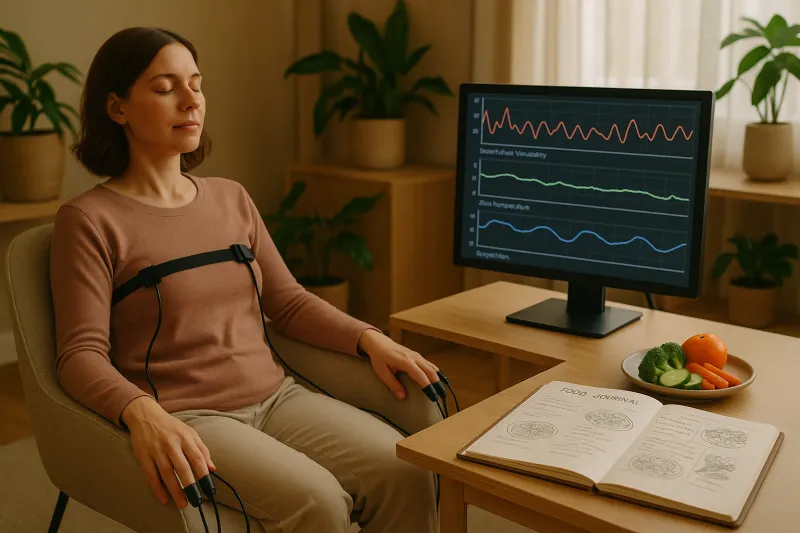
Photo: person wearing biofeedback sensors breathing calmly in clinical therapy room, via vita4life.net
Anxiety disorders affect an estimated 40 million adults in the United States, making them the most prevalent category of mental health conditions in the country. Despite decades of pharmacological advancement, a significant portion of patients report only partial relief from medications, while others express a strong preference to reduce or eliminate pharmaceutical dependence altogether. Into this landscape, respiratory biofeedback has emerged not as a wellness trend, but as a clinically measurable intervention — one that is quietly redefining what it means to treat anxiety at its physiological source.
The premise is grounded in well-established neuroscience. Breathing is the only autonomic function over which humans can exert voluntary control, making it a uniquely powerful lever between the conscious mind and the body's involuntary stress response systems. What biofeedback adds to that relationship is precision: rather than simply being told to "breathe deeply," patients receive continuous, real-time data on respiratory rate, inhalation-to-exhalation ratios, thoracic versus diaphragmatic movement, and the downstream effects those patterns have on heart rate variability and cortical arousal. For the first time, the invisible becomes measurable.
Why Traditional Breathing Exercises So Often Fall Short
The failure of conventional breathing techniques is not a failure of the concept — it is a failure of feedback. When a clinician instructs a patient experiencing acute anxiety to practice slow, diaphragmatic breathing, that patient is typically operating under precisely the neurological conditions that make self-assessment least reliable. Elevated cortisol, heightened amygdala activation, and sympathetic nervous system dominance all conspire to distort a person's perception of their own physiological state. Patients frequently believe they are breathing slowly and calmly when objective sensors tell an entirely different story.
This is the fundamental gap that respiratory biofeedback addresses. By displaying breathing waveforms in real time — often alongside corresponding heart rate variability curves — biofeedback systems provide patients with an external reference point that the anxious brain cannot distort. The feedback loop is not metaphorical; it is electronic, precise, and immediate. Patients learn not merely that they should breathe differently, but exactly how their current breathing pattern is sustaining their physiological distress, and they can observe the moment their nervous system begins to shift.
The Science of Respiratory-Cardiac Coherence
At the center of respiratory biofeedback's effectiveness is a phenomenon known as respiratory sinus arrhythmia — the natural oscillation of heart rate that occurs in synchrony with inhalation and exhalation. When breathing is slow, rhythmic, and diaphragmatically driven, this oscillation becomes amplified and coherent, a state associated with parasympathetic dominance, reduced cortisol output, and decreased activation of the brain's threat-detection circuitry.
Research published in peer-reviewed journals, including studies from institutions such as Harvard Medical School and the Cleveland Clinic, has demonstrated that patients who achieve resonance frequency breathing — typically between 4.5 and 7 breaths per minute — show measurable reductions in anxiety symptom scores, often comparable to those achieved through low-dose pharmacotherapy. Crucially, biofeedback allows patients to identify their individual resonance frequency, which varies from person to person and cannot be determined through self-report alone.
From the Clinical Record: Patient Experiences With Respiratory Biofeedback
Consider the case of a 34-year-old marketing professional from the Chicago area who presented with generalized anxiety disorder and had been managing symptoms with a selective serotonin reuptake inhibitor for six years. She described her anxiety as "always present in the background" despite medication compliance, and she reported that guided breathing exercises during therapy sessions left her feeling "like I was doing it wrong but couldn't tell why."
Following a structured course of respiratory biofeedback sessions, she was able to observe directly that her resting breathing rate averaged 18 to 20 breaths per minute — nearly double the rate associated with parasympathetic recovery. More significantly, she could see on the monitoring display the precise moment her exhale shortened under stress, a pattern she had never consciously detected. Over twelve sessions, she trained her resting respiratory rate down to 11 breaths per minute and, in consultation with her prescribing physician, began a gradual tapering protocol that ultimately reduced her medication dosage by half.
A second case involves a 52-year-old retired firefighter from the Dallas-Fort Worth region presenting with anxiety rooted in occupational trauma. He had resisted pharmaceutical intervention on principle and had found mindfulness-based approaches "too abstract" to be practically useful during moments of acute distress. Respiratory biofeedback gave him what he described as "something concrete to work with" — a visual display he could interpret as clearly as an instrument panel. Within eight sessions, his biofeedback data showed a 34 percent improvement in heart rate variability coherence scores, and he reported a marked reduction in the frequency and intensity of anxiety episodes.
Interrupting the Anxiety Cycle Before It Escalates
One of the most clinically significant applications of respiratory biofeedback lies in what practitioners refer to as early-cycle interruption. Anxiety disorders frequently follow a recognizable physiological trajectory: a triggering stimulus initiates subtle changes in breathing pattern, those changes reduce oxygen-carbon dioxide balance, which in turn amplifies sympathetic activation, which further dysregulates breathing — a self-reinforcing loop that can escalate to a full panic episode within minutes.
Biofeedback monitoring allows patients to detect the earliest respiratory signatures of this cycle — often before they are subjectively aware that anxiety is building. Over time and with repeated practice, patients internalize these signals as somatic awareness, developing what clinicians describe as interoceptive literacy: the capacity to read their own internal state with accuracy and respond before dysregulation becomes entrenched. This is not simply relaxation training. It is the systematic development of a physiological skill.
What Biofeedback Offers That Pharmaceuticals Cannot
Pharmaceuticals for anxiety operate systemically, altering neurotransmitter dynamics across the entire brain and body. For many patients, this broad mechanism of action is both their strength and their limitation. Medications cannot teach the nervous system to self-regulate; they manage symptoms without building the underlying capacity for autonomous recovery.
Respiratory biofeedback operates through a fundamentally different mechanism. It is, at its core, a learning technology — one that leverages the brain's neuroplasticity to establish new regulatory pathways through repeated, reinforced practice. The clinical literature suggests that gains made through biofeedback training tend to persist after the formal treatment period ends, because they reflect genuine neurological reorganization rather than chemical management of an unresolved deficit.
This is not to suggest that biofeedback and pharmacotherapy are mutually exclusive. Many patients benefit from a combined approach, using medication to provide initial stabilization while biofeedback training builds the long-term regulatory skills that may eventually reduce pharmaceutical necessity.
A Measurable Path Forward
For patients and clinicians alike, the appeal of respiratory biofeedback lies significantly in its transparency. Progress is not a matter of subjective report or clinical impression — it is visible in waveform data, coherence scores, and heart rate variability indices that can be tracked session by session. In a field where treatment efficacy has historically been difficult to quantify, that measurability represents a meaningful advance.
As anxiety disorder rates in the United States continue to rise — a trend accelerated by the social and economic disruptions of recent years — the demand for effective, non-pharmaceutical interventions has never been greater. Respiratory biofeedback does not promise simple answers. It offers something more durable: a structured, evidence-informed method for patients to understand their own nervous systems and, over time, to become active participants in their own recovery.
The breath has always been there. Biofeedback simply makes it legible.