Your Slouch Isn't a Habit Problem: What Biofeedback Data Reveals About the Body-Mind Architecture of Postural Tension

Photo: David Francis Barry, Public domain, via Wikimedia Commons
The Ergonomic Industry's Blind Spot
Walk into any open-plan office in America and you will find the same scene: ergonomic chairs adjusted to precise angles, monitor risers positioned at eye level, and employees still hunched forward by mid-afternoon, shoulders drawn inward, necks craning toward their screens. The equipment is correct. The posture is not. For decades, the dominant explanation has been behavioral — people simply forget to sit up straight, or their core muscles are too weak to sustain proper alignment. Sell them a better chair. Remind them with a phone notification. Strengthen their glutes.
Real-time biofeedback data is beginning to dismantle that explanation with uncomfortable precision.
When practitioners at biofeedback clinics attach surface electromyography (sEMG) sensors to the trapezius, rhomboid, and paraspinal muscle groups of patients who report chronic postural discomfort, the readings rarely match the picture of simple muscular weakness. Instead, they reveal persistent low-grade activation — muscles that are not weak at all, but chronically contracted, bracing against something that has nothing to do with the angle of a monitor.
What the Sensors Actually Show
In a standard biofeedback assessment, sensors translate physiological signals into visual or auditory feedback that both the clinician and the patient can observe in real time. When postural muscles are mapped this way, a striking pattern emerges among individuals who carry significant psychological stress: the upper back and neck musculature remains in a state of partial contraction even during rest, even when the person believes they are relaxed, and even when their posture looks acceptable from the outside.
This is the measurement gap that self-reported wellness cannot bridge. A person may genuinely feel that they have unwound after a stressful workday. The sEMG trace, however, may show trapezius activation levels that are physiologically indistinguishable from moderate physical exertion. The body has not received the message that the threat has passed.
Perhaps more revealing is what happens when these same patients are asked to recall a stressful memory or anticipate an anxiety-provoking event while sensors remain attached. Postural muscle tension increases measurably — often within seconds — without any change in the person's seated position. The emotional content alone drives the physical bracing response. This is not metaphor. It is data.
The Nervous System as Architect
To understand why this happens, it helps to consider the autonomic nervous system's role in physical structure. The sympathetic branch — responsible for the fight-or-flight response — does not confine its effects to heart rate and cortisol. It recruits skeletal muscle in preparation for defensive action. The shoulders rise. The chest narrows. The head moves forward, reducing peripheral vulnerability. This postural configuration is ancient, deeply wired, and entirely appropriate when a genuine physical threat is present.
The difficulty arises when chronic psychological stress — financial pressure, relational conflict, professional overwhelm, or unprocessed traumatic memory — keeps the sympathetic nervous system in a state of partial activation for months or years. The body maintains its defensive architecture indefinitely, not because of poor ergonomic habits, but because the nervous system has not received sufficient evidence that safety has been restored.
Traditional ergonomic interventions address the shape of the posture without addressing the signal generating it. Asking someone to pull their shoulders back while their nervous system is broadcasting a low-level threat alert is, in physiological terms, asking them to manually override an automated protective response. It is exhausting, unsustainable, and ultimately beside the point.
Where Biofeedback Therapy Differs
Biofeedback therapy does not ask patients to force their bodies into correct positions. It teaches the nervous system to genuinely downregulate — to move out of sympathetic dominance and into the parasympathetic state in which muscular bracing naturally releases on its own.
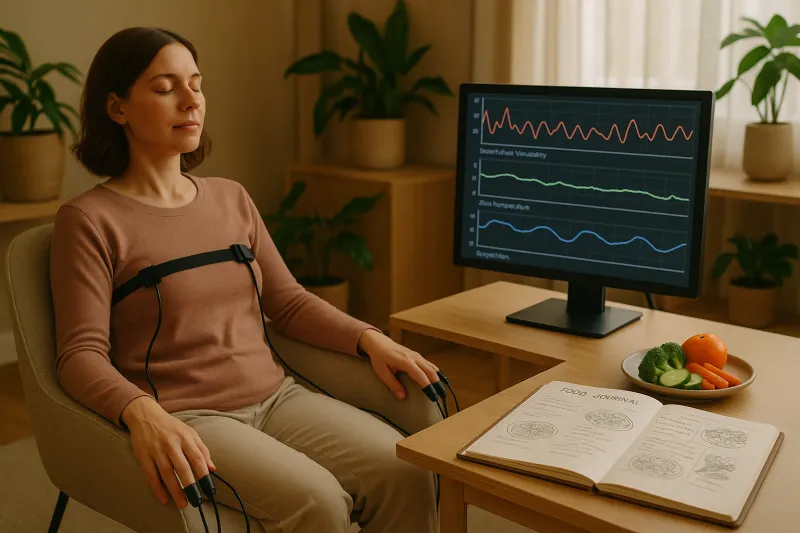
During a structured biofeedback session, a patient observes their own physiological data in real time: muscle tension readings, heart rate variability, skin conductance, or respiratory patterns, depending on the modalities in use. With guidance from a trained clinician, they experiment with breathing techniques, mental imagery, and attentional shifts, watching the feedback displays respond to each adjustment. Over time, the nervous system learns — not intellectually, but somatically — that it can move between arousal states voluntarily. The postural muscles, no longer required to sustain a defensive brace, begin to release.
Patients frequently report that this release feels qualitatively different from the temporary relief of a massage or a yoga class. Rather than a brief window of relaxation before tension reasserts itself, they describe a more durable shift — a sense that their body has stopped working against them. The biofeedback data tends to corroborate these reports, showing measurable reductions in resting muscle activation that persist between sessions as the training progresses.
Trauma, Posture, and the Stored Body
For some patients, the emotional content driving postural tension extends beyond everyday stress into the domain of unresolved trauma. Research in somatic psychology has long suggested that traumatic experience is encoded not only in memory but in the body's habitual patterns of tension and movement. A person who experienced prolonged threat in childhood may carry a protective postural contraction into adulthood as an automatic default — one that no amount of ergonomic correction will touch.
Biofeedback offers a non-invasive way to approach this territory. By making the body's tension patterns visible and measurable, it creates a bridge between the somatic experience and conscious awareness, allowing patients to begin recognizing the emotional correlates of their physical holding patterns. This is not psychotherapy, and biofeedback practitioners are careful to work within their scope of practice. However, the data that emerges in sessions can be profoundly informative, and many patients find that biofeedback work complements and deepens whatever psychological support they are receiving.
Rethinking What "Better Posture" Actually Means
The cultural conversation around posture in the United States tends to frame it as a discipline problem — a matter of willpower and consistency. Stand tall. Set a reminder. Buy the posture corrector. This framing places the burden of change entirely on conscious effort, ignoring the autonomous processes that govern how the body holds itself.
Biofeedback reframes the question. Rather than asking how a person can force better alignment, it asks what the nervous system needs in order to release the tension that is preventing alignment in the first place. That is a fundamentally different therapeutic target, and it leads to fundamentally different outcomes.
For the many Americans who have tried every ergonomic solution available and still find themselves braced, contracted, and uncomfortable by the end of a workday, this reframing may represent the most significant shift in perspective they have yet encountered. The problem was never the chair. It was never the screen height. It was the signal running beneath all of it — and biofeedback is one of the few tools capable of measuring, and ultimately changing, that signal directly.